Five Keys
- Noel Castro
- Mar 13
- 8 min read

I had originally written this article around 2010 and I feel that it is still valuable today and worth rehashing.
In my opinion and experience, there are five important keys to martial arts in relation to winning or surviving.
Footwork & Timing

Mobility is of utmost importance during a confrontation. Mobility is not just motion moving around or bouncing up and down, but it is inclusive of balance, weight transfers, directional changes, distancing, angling, etc. When your footwork is smooth, you can use your footwork to misdirect your opponent, set up for advantageous positioning, brace or deflect, and run. Footwork also includes what is traditionally called “stances.” Stances and postures taught traditionally and done in forms are snapshots of movement.
A stance as taught in a form or drill is a snapshot of movement. In practice it is done slow and paused, that is to build muscle memory and dynamic strength. It should never be static or slow when applied in real life. With proper footwork and distancing, practiced in realistic drills and sparring, it will be more apparent. In our style we use a footwork matrix. You can see that the footwork patterns of many practical martial arts have similarities.
Timing is so very important, and I relate it mostly to footwork. During a confrontation or match, both players are in constant motion, to have maximum strength, economy of motion, agility, one has to have proper timing of the feet and hands and body. Without timing or footwork, flailing the arms or legs about will be a monstrous disaster. Timing is best practiced and applied by understanding your own body’s rhythm. In our system, we use full beat, half-beat, full step, half-step, and broken rhythm.
When you understand timing and footwork, you will be able to find entry points for attack, setup, and retreat. If you can disrupt or break your opponent’s timing and footwork, the scales tip greatly in your favor.
Strength & Endurance

If one doesn’t even have a basic amount of strength, no matter how many times he hits his opponent, it will not end the fight quick enough and there will be danger that he can’t win or even not survive (of course this is counting without an equalizer–weapons). During any martial art training, one has to develop a certain amount of strength so that the technique applied will work on the other person(s) involved. One doesn’t have to be a hulking brute, but strength really matters, no matter what some say.
Even with use of hand tools, weapons, or other equipment to enhance your effectiveness enough strength must still be applied to use the tool effectively. For example, if a child swings a stick at you it might hurt but it won't likely be debilitating. However if a large man swung that same stick, that impact will be bone breaking or debilitating. Knowing how to use your body to apply all the muscles in your body rather than just an arm to deliver a strike also makes a big difference. This can also be seen in the measured PSI difference when striking with professional boxers vs untrained persons.
Strength also includes the ability to take hits. It is an unfortunate reality, but we will all get hit. Some more than others, but we will get hit and often the other guy will hit you very hard. If our internal body condition is not strong enough, we will be broken down quickly by strong hits. So developing the body’s natural strength is a must.
Endurance is the counterpart to strength. Endurance allows you to use your strength, techniques, and everything you need to do for an amount of time. The better your endurance, the longer you can function at a higher output. Endurance also plays importance when running or escaping, because in self-defense, if you can’t get away you’ll have to fight, and if you got tired and worn out trying to get away, how could you fight when they catch up to you? Anyway, being able to move while breathing and applying force and not succumbing to fatigue when you need to exert yourself is paramount. Mainly, be healthy enough to not gas out before the other guys.
Experience
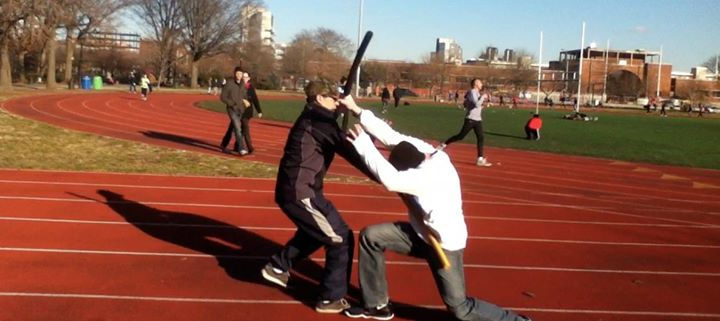
Probably one of the most important points. When one has a certain amount of practical experience, he will be able to judge himself correctly, judge the situation properly, and thus be able to handle things well. Whether it is to advance the fight or run away. One that is experienced will also be less surprised and have a quicker recovery time when something goes terribly wrong.
Experience I feel is not measured just by the number of fights or years of training, but how one changes and adapts after each fight and the quality of each round. It is not just how many “wins” but even more the “failures” that can change one’s understanding and viewpoint of how to fight or defend himself. If in training, one always has the same shortcoming, probably they haven’t used those opportunities or failures to gain an experience, but just “took the hits” and thought they were already doing well.
To truly gain experience, one must be humble. Quality experience can only be had when you train and try your art out of the comfort zone, and outside your school’s training regulations and familiarity. For example, you might be great at your art and in your art’s rules, however if the rules are changed, how will you adapt? Have you experienced it? What if there’s another surprise, like a second or third or fourth attacker? What if they change the rules on you mid fight? A hidden weapon?
Experiencing things like that outside your school or teacher’s rules and comfort zone is important to gain a higher level of experience.
In a self-defense situation, your attacker or attackers will likely be stronger than you and will likely have weapons. It is vital to include weapons and hidden weapons to your training. And even more vital your training is often outside your comfort zone. Practice to the point of failure often to be aware of your weaknesses and change them. "Die" in training so you "die less often" in real life (for those in security or law enforcement, I highly recommend Dog Brother's DLO training as a good start).
Speed

The importance of speed can be seen a few ways. Some think that the “fastest” will be better. And I used to think that also when I was younger. Being lightweight, I was naturally faster than most and used it to my advantage. However, fighters that are slower and more experienced will still overcome a fighter that is “faster.” In Eskrima for example, we learn that one should strive to be as fast as possible, to move faster than the opponent can react. Overwhelm the opponent so he has no chance to initiate an attack…
However in Wing Chun, we learned speed is truly relative. If you have the proper skill and experience, you can slow down the faster opponent to play at your speed or speed them up to the point their technique becomes unreliable. Thus fighters with more experience can control the situation and speed of their opponent’s attacks. So in my experiences, train to improve your speed, but also training to control the other person’s speed is a great combination to have.

Going further, speed is even more the “reaction time” of a person, rather than the speed of his punch or kick. When a confrontation happens how you react and what you choose to do is your speed. We practice a flinch reaction, so that in any situation, you can use that initial flinch to put you in an advantageous position to buy time for your reaction and set up. Speed is increased when practicing high percentage techniques and training reaction. If you have fewer techniques to choose from, and the techniques can be exchanged and combined easily and instinctively, your speed increases.
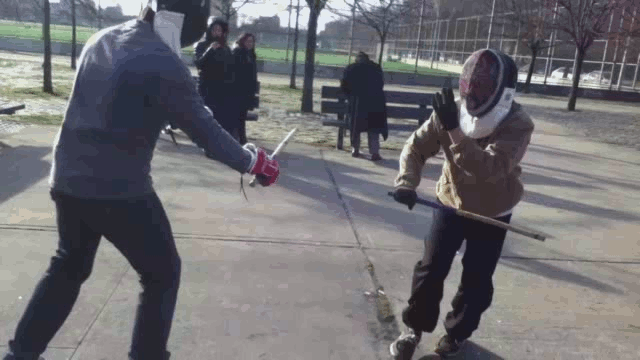
For example, a friend of mine and one of my students were practicing. My friend is quite fast, faster than my student, more flexible, and had more tournament experience. But he didn’t have as much experience fighting against different styles. He was specialized for tournament and tournament rules. My student had no previous experience, flinched at anything coming at him, and was a blank slate. Teaching my student principles and a smaller toolset to work with, I had taught my student how to funnel and set up others into his workspace.

At first, my friend pummeled my student. It was expected. But after a few months of training, my student and friend gave it another try and the result was very different. My friend asked me what I was teaching my student, because he never expected someone to improve that quickly. In about a half year of training, my student who began with nothing, was giving a martial artist with nearly 20 years of experience a run for his money. He said my student was extremely fast and wanted to know how to train speed. The difference, is training the principles of how to use body mechanics, footwork, and technique to fight for your life and control the situation vs trying to set up a person to get a few points and using your natural speed to compete with another person.
Willpower
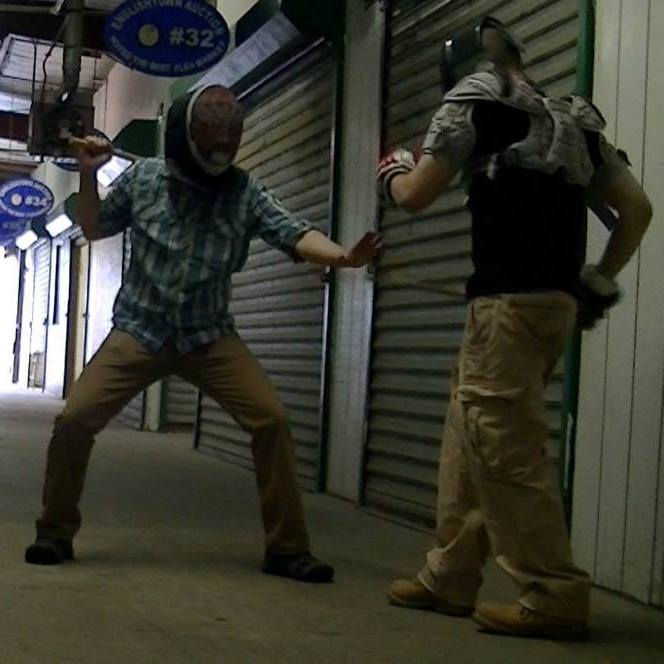
Finally is willpower. I believe this is the trump card of the Five Keys, because this is the expression of our spirit during the match. If we have the heart not to fail, never yielding nature, and if we can sum up the courage in the time we need it most, then perhaps our will to overcome will be the edge we need to compensate for our other lackings. If one can harness this, he will be able to stand firm when needed. Willpower is directly related to fighting spirit and the will to survive. In a confrontation often when one side sees the drive and willpower of the other exceeds his own, then some changes can start to take place. The one with less will and fighting spirit will begin to make mistakes and either flee or lose.

Willpower is something that can be trained to an extent. Physical training and pushing yourself is one aspect. But internally it is related more or less to your spirit. Do you want to survive? What do you have to survive for? It is important to train especially for women’s self-defense. Unfortunately the media, society, and many things we meet on a daily basis will slowly whittle away at our willpower. Either by giving us a sense of hopelessness or by “enabling” people to be coddled to an extent they need care takers, and even more when society biases crush people’s ability even to speak freely. Being submissive as a society has also damaged our willpower.
Take for example, the difference between a felon getting shot and a regular person being shot. The felon getting shot, will probably last a bit longer because he doesn’t want to be caught, he will run if he can, even if he was shot. He will run and fight for his life until he can’t move anymore. A person who never has seen violence, gets shot and he can relate to movies and TV. A person who is shot, should lie down powerless, because that is what he saw in the movies. Fear overcomes the person and thoughts of dying play over and over in his head.
It is vital to overcome society’s crippling of willpower and find your source. What do you live for and for whom will you survive? Regardless what martial art you practice, without willpower you will fail.
I believe that understanding these Five Keys will give any martial artist an edge.
Comments